“But We Have Learned a Good Deal, You Perceive”: What the Heck is “Deal”?

Deal table, circa 1900
(This took a fair amount of Googling, since the algorithm thinks you intend the commercial meaning of “deal.”)

When the group discussed “The Man with the Twisted Lip” at our last meeting, it was the second Holmes case we’d read in a row (following “The Red-Headed League”) to feature the kind of wood called “deal.” In REDH, it was the material of some cheap furniture in the League offices; in TWIS, it made up the box that held the building bricks Mr. Neville St. Clair had bought for his son. It will crop up again for us next month in “The Empty House,” in which we learn that Holmes conducted his chemical researches on a “deal-topped table.” But what in the world is “deal”?

The question intrigued NMSOBC member Ken Meltsner (“The Hiding-Place Under the Carpet”), himself an amateur woodworker. Despite the minor handicap of originally believing that the blocks, and not the box holding them, were made of deal, he put together a PowerPoint presentation about the matter, which we will now share here.

As a newcomer to making such presentations, Ken began by explaining how he decided on his topic, using some spousal advice from your humble Gazetteer:

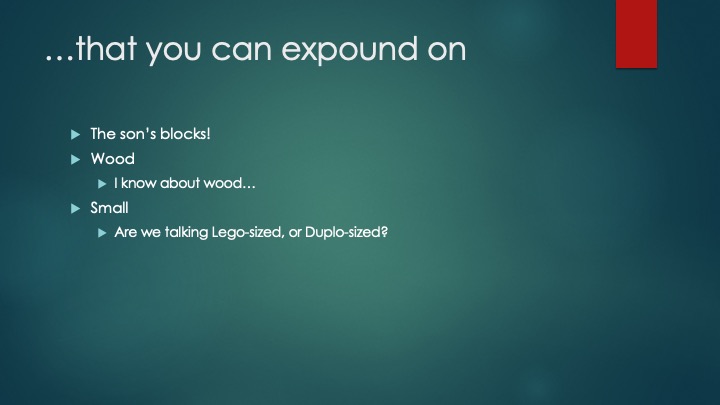
He followed by explaining what deal wood was (essentially, cheap planks of softwood), what it is now, and the origin of the word.

And, in this addendum, noted his original error, which answers the question he raised as to why the bricks would be made of deal, since blocks are usually made of hardwood.

So, despite a misreading, some interesting and useful background information for modern-day Americans trying to make sense of Watson’s accounts.

“The Empty House” Added to May Meeting

Cover illustration by Frederic Dorr Steele

At NMSOBC member Christine Ellis’s suggestion, we’re adding “The Empty House” to our May 2 discussion of “The Final Problem” at our virtual meeting. Take note and read up, all!

“We Have Much to Hope from the Flowers”: A Study in Resilience

Not directly related to Holmes, but I wanted to share this article because (a) Sherlock would have appreciated it, and (b) it cheered me up a bit amid the continuing pandemic.

https://www.vox.com/science-and-health/2020/4/14/21208857/pandemic-plants-evolution-beauty

Stay home, and stay safe, everyone!

Good News for Biblioholics: LibraryThing Cataloging Site Now Free to All

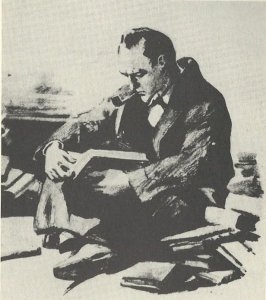
Frank Wiles, “The Adventure of the Veiled Lodger,” 1927

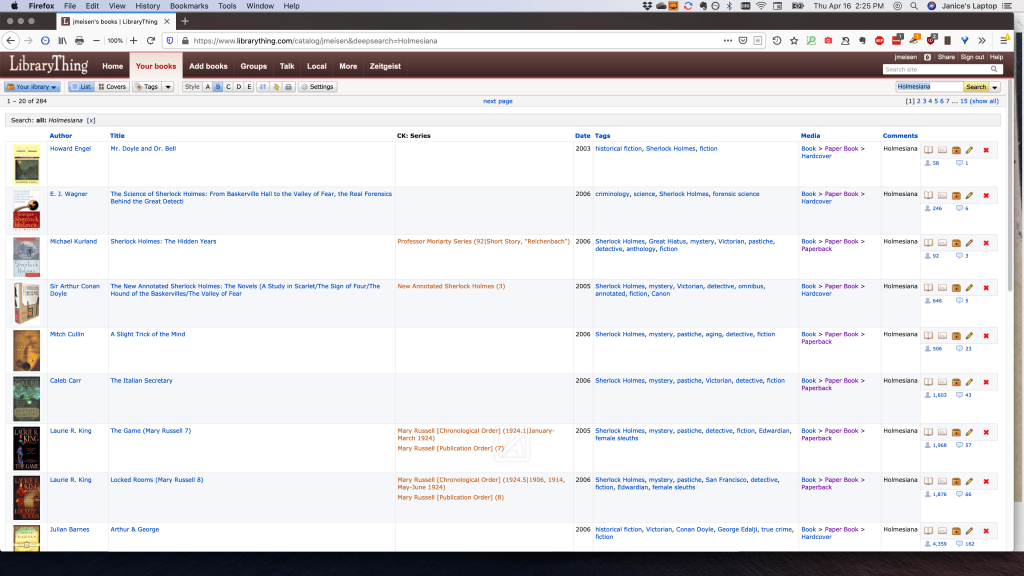
Lomax, the Sub-Librarian would applaud. LibraryThing, the site your humble Gazetteer has used to manage her collection of books for about 15 years, has now removed all fees and book limits, without the addition of ads. The fees were always low, but in response to the global pandemic, both the site and its mobile app (which allows you to add books by using the phone’s camera to scan the ISBN barcodes) are now completely free to use.

Your Gazetteer has long preferred LibraryThing to GoodReads, and is taking this opportunity to recommend it to all. It’s flexible and easy to use, and it includes enjoyable social features (while allowing you to keep your library or individual books private if you desire).

Some of the Gazetteer’s books

Your book information is not collected for marketing; the site uses it only for gathering information on books and authors (as in this page for Arthur Conan Doyle). Members also engage in collective endeavors such as entering the personal libraries of famous people. This is an excellent opportunity to give it a try.

Perhaps it will even spur the Gazetteer to finish entering all of her books.

Note: This is not an official endorsement by the NMSOBC.

“The Irregulars’ Room”: A Forgotten Piece of Sherlockiana

I recently bought a used copy of Profile by Gaslight, edited by Edgar W. Smith, the first mainstream publication of Sherlockian scholarship. To my surprise, it was a first edition, acquired on July 29, 1944, according to the original owner’s note on the title page. I flipped through the book, and tucked next to Vincent Starrett’s “221B” was this newspaper clipping.

To save everyone’s eyes, I’ll transcribe the poem here. The clipping is from the Chicago Tribune of Wednesday, March 11, 1964, and includes this explanatory note: “Last night marked the dedication of the Irregulars’ Room in Sage’s restaurant at 1 N. La Salle. This is the only public Sherlockian room in the United States.”

The Irregulars’ Room
by Robert W. Hahn

Here dwell, dear Sherlock, here, within these walls,
With your test tubes, violin, pipe, and shag.
And when your voice, sharp with excitement, calls
“Come! The game is afoot,” we will not lag
But speed to stable or ancestral halls,
In train or hansom or colonel’s drag;
And watch your piercing eyes and mind
Find clews to which Lestrade is blind.
Then, with the culprit safe in custody,
Return with you to 221B,
And gasogene, tantalus, pipes, and fire,
To await the next client with tale so dire.
For in that land or eighteen-ninety-five
We, your faithful Watsons, best survive.

Not a literary masterpiece, perhaps, but an admirable sentiment nonetheless. I hope other faithful Watsons enjoy Mr. Hahn’s work as well.

From Janice M. Eisen (“Maggie Oakeshott”), Gazetteer